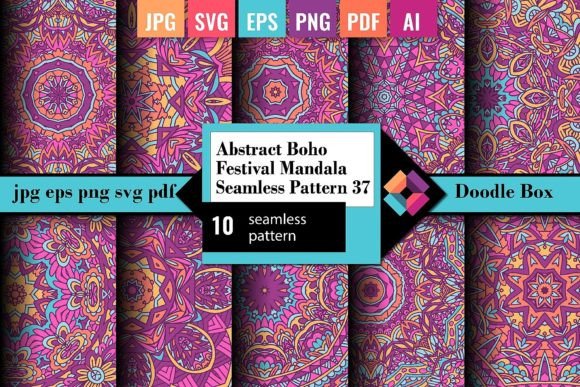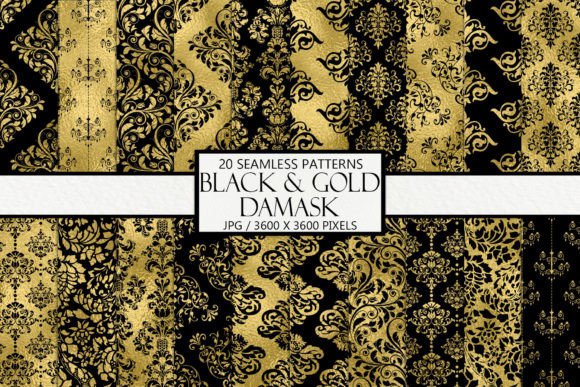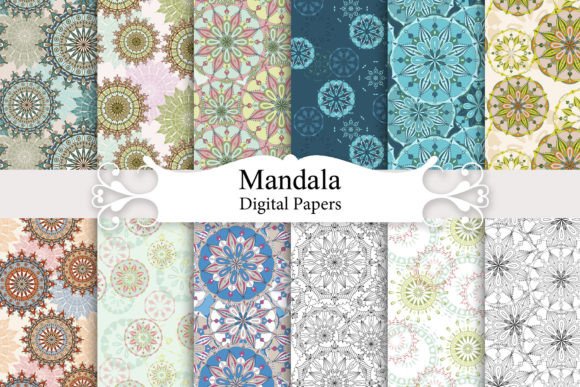
Mandala Seamless Papers
Imagine opening a kit and finding twelve rich, intricately balanced mandala patterns—each one designed not just to look beautiful, but to work. Mandala Seamless Papers deliver exactly that: high-resolution, tileable JPEGs (16×16 inches at 300 DPI) built for real-world creative use. No awkward seams. No visible repeats. Just clean, scalable design foundations you can stretch across a mural or shrink into a fabric swatch—without losing integrity.
Why Seamless Matters More Than You Think
“Seamless” isn’t just a buzzword—it’s functional precision. When a pattern tiles flawlessly, it eliminates visual breaks that distract the eye or undermine professionalism. That means when you’re designing custom wrapping paper for your small-batch candle brand, laying down a background for an Instagram carousel post, or printing a large-format wall decal for a yoga studio, the repetition feels intentional—not accidental. With Mandala Seamless Papers, you’re not just copying and pasting; you’re building continuity. One image becomes a field. Two become a rhythm. Ten become an environment.
Creative Uses That Go Beyond “Pretty Backgrounds”
These aren’t decorative afterthoughts—they’re flexible raw materials. Here’s how different creators are putting them to work:
- Scrapbookers and journal artists use individual tiles as layered underlays beneath handwritten quotes or photo collages—then scale up a second tile to frame the entire spread, creating cohesion without monotony.
- Apparel designers test repeat placement on mockup tools before sending files to print-on-demand partners. Because each pattern is truly seamless, they avoid costly revisions caused by misaligned edges on t-shirts, tote bags, or scarves.
- Educators and therapists print single tiles at poster size for mindfulness exercises—or shrink them into printable coloring sheets. The symmetry supports focus; the resolution ensures crisp lines even when enlarged for classroom walls.
- Bloggers and content creators apply subtle mandala overlays (at 5–10% opacity) behind text blocks in Canva or Adobe Express. It adds quiet visual texture without competing with readability—a small detail that lifts perceived polish.
- Paper product makers (think greeting cards, notebooks, gift tags) use the same file across multiple SKUs. A single mandala pattern might appear as a foil-stamped border on a card, a blind-embossed liner inside a notebook, and a full-bleed wrap for a box—all sourced from one consistent, high-DPI JPEG.
Designing with Intention, Not Just Repetition
Tiling is powerful—but repetition alone doesn’t guarantee impact. To keep results clear and audience-friendly, consider these practical filters before committing to a layout:
- Scale context first. A dense mandala works beautifully on a 4×6 inch coaster but may overwhelm a smartphone lock screen. Preview your tile at actual output size—not just zoomed in on your desktop.
- Test contrast early. If using over photography or textured surfaces, drop the pattern to 20–40% opacity and adjust brightness/contrast in your editing tool. Mandala Seamless Papers include rich mid-tones, so minor tweaks often reveal more versatility than starting from scratch.
- Respect hierarchy. When layering text or icons, treat the mandala as atmosphere—not competition. Use white space, bold typography, or strategic cropping to ensure your message stays legible and grounded.
- Stay consistent within a project. If you choose one mandala for your business card, use variations of the same pattern (rotated, recolored, or masked) across email headers and social banners. Consistency builds recognition faster than variety ever could.
Adapting Across Platforms and Audiences
What works for a handmade stationery shop won’t always resonate with a wellness coach launching a digital course—but Mandala Seamless Papers adapts naturally. A marketer building a lead magnet might use a lighter, airier mandala as a subtle watermark behind a PDF checklist. A freelance illustrator could embed one as a repeating texture in Procreate brushes for hand-drawn lettering. An educator preparing printable worksheets might invert colors (black mandala on white → white mandala on navy) to reduce ink usage while preserving clarity.
The key is matching pattern density and contrast to function. Busier mandalas suit tactile products (fabric, packaging, printed journals) where viewers engage up close. Simpler, more open designs translate better to digital interfaces—especially on mobile, where fine detail can blur or disappear.
Realistic Tips for Getting Started
You don’t need advanced software to begin. These low-barrier approaches deliver strong results fast:
- Drag a JPEG into Canva, set it as a background, and use the “repeat” toggle—no manual tiling required.
- In Photoshop or Affinity Photo, convert the layer to a Smart Object, then use Edit > Fill > Pattern to auto-tile at any canvas size.
- For physical prototyping: print one tile on standard letter paper, cut it into quarters, and tape them together edge-to-edge. This gives immediate feedback on how the repeat reads in real life—before ordering large-format prints.
- Want to customize color? Open any JPEG in a free editor like Pixlr, use Hue/Saturation to shift tones, and save a new version. All twelve base patterns hold up well to subtle recoloring.
Not Just Inspiration—Infrastructure for Making
Mandala Seamless Papers is infrastructure disguised as art. It’s the kind of resource that disappears into your process—supporting your voice instead of defining it. You’re not buying “mandala graphics.” You’re acquiring reliable, production-ready assets that handle technical heavy lifting so you can focus on meaning, messaging, and connection.
Whether you’re sketching a logo concept, prepping files for a print run, designing a virtual workshop slide deck, or refreshing your Etsy banner—these twelve files offer consistency without constraint. They’re neutral enough to serve your vision, detailed enough to stand on their own, and seamless enough to scale without compromise.
That’s the quiet power of thoughtful design tools: they don’t shout. They simply make what you already do—clearer, faster, and more confident.