Flora Fauna in Art Craft - Set 3: Vintage Botanical Precision for Intentional Creative Work
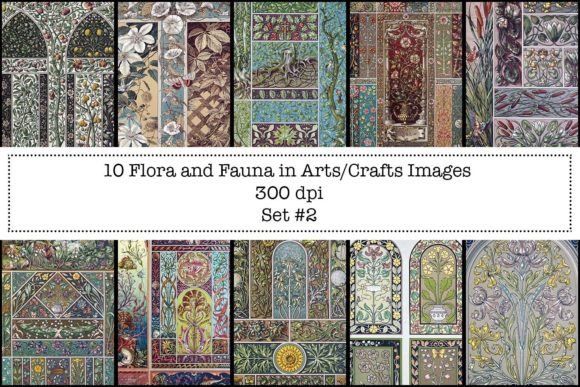
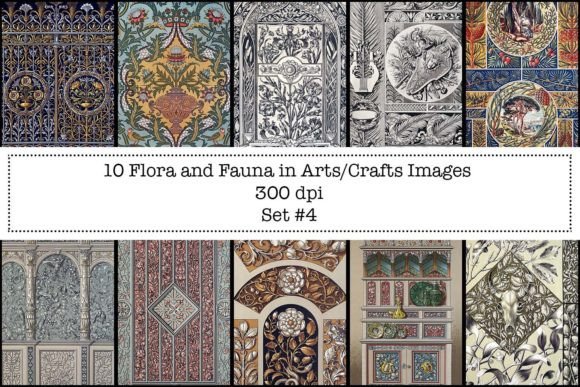
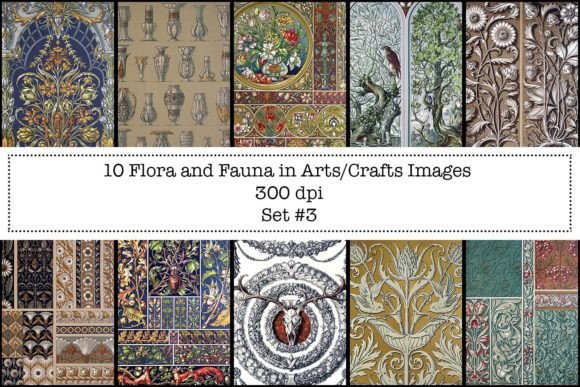
Flora Fauna in Art Craft - Set 3 delivers ten meticulously preserved botanical and zoological pattern images drawn from Anton Seder’s 1886 publication Die Pflanze in Kunst und Gewerbe—a foundational text bridging scientific observation and applied design. These are not stylized reinterpretations or AI-generated motifs. They are original late-19th-century engravings, scanned at 300dpi, lightly restored only where physical wear compromised legibility—cropped for clarity, spot-healed where paper tears or stains obscured detail. The result is a set of historically grounded, high-fidelity visuals that retain their archival texture and compositional authority.
Why This Set Fits Strategic Creative Practice—Not Just Aesthetic Preference
Choosing Flora Fauna in Art Craft - Set 3 isn’t about adding “vintage charm” to a project. It’s about selecting source material with built-in coherence, historical credibility, and functional versatility. Seder’s work was created for designers, educators, and manufacturers—intended for reproduction across textiles, wallpaper, ceramics, and instruction manuals. That purpose remains intact today: each image functions as a modular, scalable, context-aware element—not decorative filler, but structural visual language.
For entrepreneurs launching a stationery line, these patterns offer immediate brand alignment with heritage craftsmanship—without requiring custom illustration. For educators building botany curriculum materials, the accuracy and clarity of Seder’s linework support learning outcomes more reliably than simplified clip art. For mixed-media artists, the consistent line weight and balanced negative space allow seamless layering over photographs, handwritten text, or painted backgrounds—no visual competition, only reinforcement.
Where Intentional Use Creates Real Leverage
Flora Fauna in Art Craft - Set 3 gains strategic value when matched to specific operational or expressive goals—not when treated as generic “vintage assets.” Consider these grounded applications:
- Product development: A small-batch textile printer uses three motifs from the set to anchor a capsule collection of linen tea towels. Because the patterns share tonal consistency and proportional logic (all derived from the same printing process and era), they read as a unified system—not a collage. Customers perceive cohesion; production avoids costly reformatting.
- Digital course design: A botany educator embeds one motif per module introduction—paired with a short annotation on its taxonomic origin or historical use in horticultural publishing. The image becomes a mnemonic device, reinforcing retention through visual anchoring rather than passive decoration.
- Brand identity refinement: A natural skincare startup replaces generic leaf icons in its packaging mockups with two Flora Fauna in Art Craft - Set 3 patterns—one floral, one insect-based—to signal precision and ecological literacy. The choice signals research depth, differentiating it from competitors relying on stock vectors.
Planning Your Use: What to Assess Before You Download
Before integrating Flora Fauna in Art Craft - Set 3 into your workflow, ask three practical questions:
- Does this image serve a defined function—or just “look nice”? If the answer leans toward aesthetics alone, pause. Random placement dilutes impact and risks visual fatigue. Instead, assign each motif a role: background texture, border element, icon replacement, or thematic accent. Document that intent before importing.
- What’s the output context—and does resolution match it? At 300dpi, these images print crisply up to 8×10 inches without interpolation. For larger wall art or fabric repeats, test scaling in your layout software first. On screen, they render cleanly at standard web resolutions—but avoid stretching them beyond native pixel dimensions in digital interfaces where sharpness affects perceived professionalism.
- How does licensing align with your business model? Flora Fauna in Art Craft - Set 3 permits commercial use in physical and digital products you create—junk journal kits, printable planners, embroidered patches, or ebook illustrations. It does not permit resale as standalone files (e.g., uploading to a marketplace as “vintage clip art”). Violating this doesn’t just risk takedowns—it undermines trust with customers who value ethical sourcing.
Risks of Context-Free Adoption
Using Flora Fauna in Art Craft - Set 3 without clear goals introduces subtle but consequential friction. A scrapbook designer who drops five motifs onto a single page without hierarchy or rhythm creates visual noise—not narrative. A blogger embedding an uncredited Seder engraving beside modern photography may unintentionally misrepresent authorship or erode credibility with historically informed readers. Worse, indiscriminate reuse across multiple product lines can flatten differentiation: if every candle label, greeting card, and tote bag uses the same vine motif, the brand loses distinctiveness.
The deeper risk isn’t technical—it’s strategic drift. When visual choices lack intention, they stop supporting outcomes and begin consuming time instead. You spend hours adjusting contrast, testing layouts, or defending stylistic choices—effort that could go toward refining messaging, improving usability, or deepening customer insight.
How to Approach the Set Like a Practitioner, Not a Collector
Treat Flora Fauna in Art Craft - Set 3 as a working toolkit—not a museum archive. Start small: select one image and define its job. Is it framing a quote? Anchoring a color palette? Replacing a generic bullet point? Then test it in context: print a draft page, view it on mobile, hold it beside your existing brand assets. Does it clarify—or complicate?
Build usage guidelines early. For teams, note which motifs suit which applications (e.g., “Motif #7: approved for packaging borders only; avoid in digital ads due to fine-line fragility at small sizes”). For solo creators, maintain a simple log: date used, project name, purpose, and outcome observed (e.g., “Used Motif #2 in workshop handout—participants referenced its clarity during Q&A”). Over time, this reveals what truly works—not what merely looks familiar.
Long-Term Value Lies in Consistency, Not Quantity
You don’t need all ten images at once. In fact, limiting yourself to three—chosen for functional fit—often yields stronger results than rotating through the full set. Consistent visual motifs build recognition faster than novelty. A customer seeing the same precise fern motif across your Instagram stories, product tags, and printed catalog begins associating it with your attention to detail. That association compounds over time; it becomes part of your brand’s quiet authority.
Flora Fauna in Art Craft - Set 3 endures because it was built for utility—not trend. Seder didn’t design for Instagram grids or Pinterest pins. He designed for reproducibility, legibility, and adaptability across media. That same durability applies now: these images won’t date quickly, won’t require seasonal refreshes, and won’t demand constant reinterpretation. They’re stable ground—not shifting sand.
Final Thought: Let Function Guide Form
Flora Fauna in Art Craft - Set 3 earns its place in your creative practice not because it’s old, but because it’s resolved. Every curve, stem, and vein was considered for clarity under press, not just composition. When you choose one of these images, you’re not borrowing nostalgia—you’re adopting a decision-making framework refined over centuries of applied design. Use it that way: deliberately, sparingly, and always in service of a tangible goal.