Flora Fauna in Art Craft - Set 2: Vintage Botanical Motifs for Thoughtful Creative Work
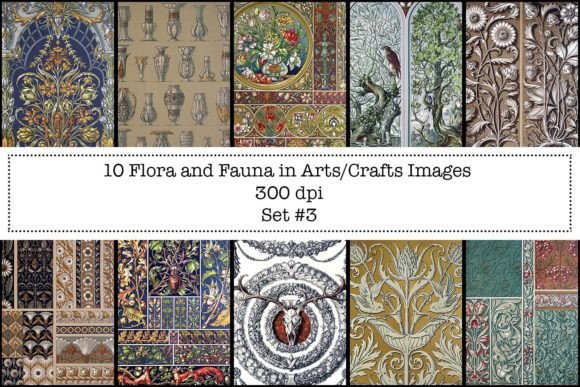
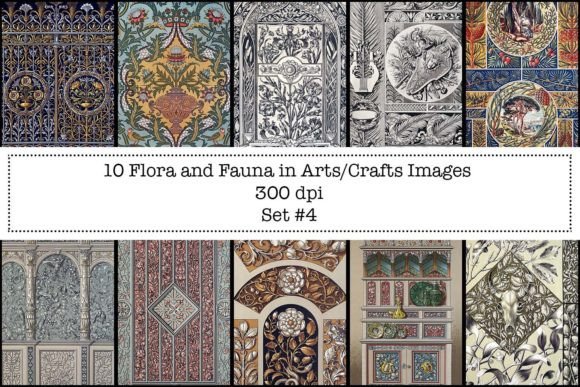
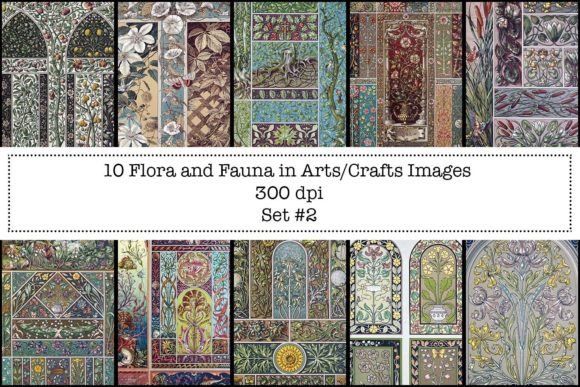
Flora Fauna in Art Craft - Set 2 offers ten high-resolution pattern images sourced from Die Pflanze in Kunst und Gewerbe (The Plant in Arts and Crafts), a late 19th-century German design reference published around 1886 under the direction of Anton Seder. These are not reinterpretations or AI-generated approximations — they’re direct, respectful digital captures of original engraved plates. Each image has undergone minimal intervention: light cropping to remove margins and subtle spot healing where paper wear or ink loss compromised legibility. The result is a set that preserves historical texture and compositional integrity while meeting modern production standards.
What Makes This Set Distinctive in Practice
Unlike many digitized vintage collections that prioritize uniformity over authenticity, Flora Fauna in Art Craft - Set 2 retains visible evidence of its origins — faint plate marks, slight tonal variations, and the quiet irregularity of hand-engraved linework. That isn’t a flaw; it’s a feature. For creators working with tactile media like junk journals or handmade stationery, these qualities translate directly into visual depth and material resonance. A scanned floral border with subtle grain doesn’t compete with watercolor washes or linen textures — it complements them.
The patterns themselves reflect Seder’s pedagogical approach: structured yet organic, precise but never rigid. You’ll find interlacing vine motifs balanced with asymmetrical leaf arrangements, stylized blossoms nested within geometric frameworks, and repeating units designed for seamless tiling — all grounded in botanical observation rather than pure abstraction. This balance between naturalism and craft discipline gives the set unusual versatility across disciplines.
Technical Execution and Real-World Usability
All ten images are delivered as JPEG files at 300 dpi, optimized for both print and screen use. At that resolution, they scale cleanly up to A4 or letter size without interpolation artifacts — important when printing onto textured paper or applying transfers. There’s no transparency layer or layered PSD structure, which keeps file sizes manageable (typically 3–6 MB each) and avoids compatibility hiccups in older design software or cutting machines.
In practice, this means Flora Fauna in Art Craft - Set 2 integrates smoothly into existing workflows. Scrapbookers can drag-and-drop into Adobe Photoshop or Affinity Photo for quick masking and blending. Educators preparing printable botany worksheets can insert motifs directly into Canva or Google Slides without color-shifting concerns. Small-batch stationery makers have used individual elements to create foil-stamped envelopes or laser-cut wooden tags — the clean line weight holds up well through vector conversion when needed.
Commercial Use Clarity and Ethical Considerations
Licensing is straightforward and creator-friendly: full commercial rights for physical and digital products, provided the images aren’t resold “as-is” — meaning no bundling into clipart packs or offering raw JPEGs for download on marketplaces. This aligns with standard ethical practice for heritage material — respecting the original work while enabling meaningful reuse. It’s particularly valuable for small business owners developing branded merchandise, such as limited-run notebooks or textile-printed tea towels, where consistent visual language matters more than novelty alone.
That said, users should note what’s *not* included: no SVG versions, no color-separated variants, and no alternate formats like PNG with transparency. If your workflow depends heavily on clipping paths or multi-layer compositing, some manual preparation will be required. Also, because the originals were printed in monochrome, all motifs are grayscale — rich in tonal range, but requiring thoughtful color application if used digitally in branded contexts.
Audience Fit: Who Benefits Most — and When
This set serves creators who value intentionality over volume. Freelance surface pattern designers exploring historical references often use Flora Fauna in Art Craft - Set 2 as a springboard for derivative work — isolating a single tendril or calyx to recombine with contemporary typography or abstract geometry. Similarly, mixed-media artists building narrative collages appreciate how the motifs carry quiet authority: a 138-year-old illustration of a climbing rose doesn’t read as “vintage aesthetic” — it reads as *evidence*, grounding personal storytelling in tangible cultural continuity.
Educators teaching design history, botanical illustration, or material culture also find practical utility here. One university instructor uses the plates to demonstrate how 19th-century design education emphasized observational rigor alongside repeat-pattern logic — assigning students to trace motifs by hand before digitizing them, then analyzing spacing ratios and symmetry systems. The clarity of Seder’s originals makes those exercises immediately accessible.
For hobbyists, the value lies in reliability. Unlike free online archives where scans vary wildly in contrast or alignment, Flora Fauna in Art Craft - Set 2 delivers predictable results. A scrapbook page built around one of these borders won’t require extensive tone correction or edge cleanup — saving time without sacrificing character.
Long-Term Value and Integration Potential
Because these motifs originate from a pedagogical source rather than a decorative catalog, they possess inherent adaptability. They don’t rely on trend-driven styling — no distressed edges, no faux-handdrawn wobble — so they age well visually. A journal spread designed today using a motif from Flora Fauna in Art Craft - Set 2 will feel coherent five years from now, not dated.
They also pair effectively with other archival sources. Users report strong synergy when combining these plates with public-domain type specimens (like those from the Hamilton Wood Type Collection) or early 20th-century textile swatches. The shared emphasis on craft precision creates cohesion across otherwise disparate assets.
One limitation worth noting: the set’s strength is also its constraint. It offers elegance and discipline — not whimsy, not maximalism, not surrealism. If your brand voice leans heavily into playful illustration or bold graphic minimalism, these motifs may require careful contextual framing to avoid tonal dissonance. They work best when supporting a quieter, more considered aesthetic.
Final Assessment
Flora Fauna in Art Craft - Set 2 isn’t about filling gaps in a toolkit — it’s about deepening practice. Its value emerges most clearly when used deliberately: as a touchstone for proportion, a reference for organic rhythm, or a bridge between historical craft knowledge and contemporary making. It suits professionals who understand that restraint, consistency, and provenance often matter more than sheer variety. Whether you’re developing a capsule collection of artisanal greeting cards, designing curriculum materials for visual literacy, or assembling a personal archive of meaningful visual language, this set delivers substance without surplus — and that kind of focused utility is increasingly rare.